The Japan Association of Nursing Programs in Universities (JANPU), established in 1975, celebrated its 50th anniversary in 2025. Initially comprising a small group of faculty members from just six universities, the association now includes all 312 nursing programs at nursing universities (institutions of higher education in nursing). They now account for approximately 40 percent of all Japanese universities.
Japan’s 295 nursing universities have an undergraduate enrollment capacity of approximately 27,000 students. For master’s programs, the capacity is approximately 3,400 students across 217 universities. For doctoral programs, the capacity is approximately 800 students across 142 universities.
JANPU's mission is to promote the enhancement and advancement of nursing education and the improvement of academic research through collaboration and cooperation among higher education institutions for nursing, thereby contributing to the health and well-being of the people. To achieve this mission, JANPU undertakes the following activities:
-
1. Conducting surveys and research on nursing education;
- 2. Quality assurance and improvement in nursing education;
- 3. Promoting educational program for Advanced Practice Nurses (APNs);
- 4. Proposing policies on nursing education;
- 5. Raising awareness of nursing science in society;
- 6. Promoting alliance and cooperation between nursing-related organizations and between Japanese and international organizations; and
- 7. Other projects necessary to achieve the objective of this legal entity
In fiscal year 2023, JANPU was commissioned by the Ministry of Education, Culture, Sports, Science and Technology (MEXT) to conduct the project Research on the Revision of the Model Core Curriculum for Nursing Education in Japan under the Leading University Reform Promotion Commissioned Program. Through this project, JANPU prepared a proposed revision of the competency-based Model Core Curriculum for Nursing Education. This proposal was subsequently published by MEXT as the Model Core Curriculum for Nursing Education (Revised FY2024 Edition) (hereinafter referred to as “Model Core Curriculum”). At the same time, JANPU has been conducting pilot projects for the JANPU Computer-Based Testing (JANPU-CBT) system to assess nursing practice competencies prior to discipline-specific clinical and regional training practice. Currently, we are developing a question-generation support system aligned with the Qualities and Competencies of the Model Core Curriculum. They are also moving forward with plans to implement CBT-based assessments of students' attainment of the required Qualities and Competencies prior to field placements in each area starting in fiscal year 2028. In fiscal year 2026, we will continue carrying out the MEXT-commissioned project, "Research on the Ideal Approach to Training Healthcare Professionals at Universities," specifically the research component aimed at improving the quality of nursing education in bachelor's degree programs. Additionally, we will continue our research on participatory clinical and regional training practice, CBT, and objective structured clinical examinations (OSCEs).
In February 2025, the Central Council for Education issued its report, Future Vision for Improving Japan’s “Collective Knowledge and Wisdom" - Reconstructing the Higher Education System (Report) Summary. Taking into account changes in social conditions—including a significant decline in the number of university entrants due to the rapid decline in the birthrate, regional disparities in higher education, particularly the severe situation in rural areas, and the need to realize learner-centered education and enhance research capabilities—the report states that the “collective knowledge and wisdom” will be enhanced by ensuring “access” to higher education, optimizing the “size” of higher education as a whole, and improving the “quality of education.” As part of this effort, a new accreditation system will be established to evaluate the quality of education on a tiered basis, and the results will be made public. It is indicated that, depending on the evaluation outcomes, institutions may be required to downsize or even close. While the number of nursing universities has expanded rapidly over the past several decades, some institutions are now experiencing difficulties in meeting student enrollment targets. The new accreditation system is therefore expected to have a significant impact on nursing universities as well, and appropriate responses will be required. We will continue to provide timely and accurate information regarding the new accreditation system its member institutions, identify the challenges they face, consider support measures aimed at ensuring educational quality, and lobby the national government when necessary.
A distinctive feature of nursing universities is that they offer practitioner-oriented education at the graduate level. According to the “Survey on the Current Status of Nursing Universities” for fiscal year 2024 (conducted in fiscal year 2025), 46.7% of graduates were from programs other than researchers' courses in master’s programs; of these, graduates from programs for advanced practice nurses—such as certified nurse specialists (CNS) and nurse practitioners—accounted for approximately 19%. In doctoral programs as well, there has been a recent trend toward an increasing number of universities establishing DNP programs for advanced practice nurses; while there are currently six such institutions, more than 30 universities are considering establishing them in the future (FY2025 Survey of Member Institutions Regarding Doctoral DNP Programs). This Council will formulate an APN Grand Design and advance reforms to the APN education system, while also working in collaboration with other organizations to realize the institutionalization of a certification system for Nurse Practitioners (tentative name). Furthermore, we will carry out activities to promote the establishment of DNP programs within doctoral programs at graduate schools.
Nursing universities are entering a new era as they respond to major societal changes and the continuing decline in the population of 18-year-olds. It is no longer sufficient simply to address the immediate challenges facing individual institutions. Rather, the time has come to reconsider the entire framework for educating the nursing workforce in Japan.
Looking ahead, it is more important than ever for our member institutions to strengthen collaboration and cooperation in advancing quality assurance and the continued development of nursing education. I sincerely appreciate the continued support and cooperation of all our member institutions and look forward to working together toward these shared goals.
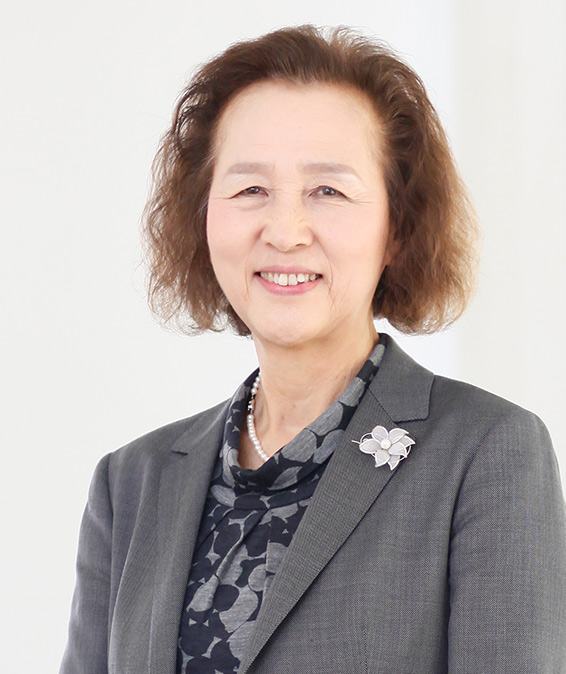
Kiyomi Asahara,
Representative Director,
Japan Association of Nursing Programs in Universities